
One of the most common questions from new patients: “How long will this take, and how long do I need to be in Saipan?”
The honest answer involves some nuance — there’s a difference between the time you need to physically be in Saipan vs the total duration of the IVF process. This guide breaks it down clearly so you can plan your travel, work leave, and budget accordingly.
Content updated: 17 November 2026; original publication date retained.
The Two-Phase Structure of IVF at SIVF
IVF at Saipan IVF Center typically involves two separate visits:
- Visit 1: Stimulation, monitoring, and egg retrieval (10–14 days in Saipan)
- Visit 2: Embryo transfer — either fresh transfer (during the same visit) or frozen embryo transfer, FET (a separate visit of 4–6 days, 6–10 weeks later)
Most patients at our clinic proceed with frozen transfer rather than fresh, because:
- PGT-A testing requires 2–3 weeks for results
- A frozen cycle lets the transfer be scheduled after the lining has been checked[2]
- Where it is suitable, success rates with frozen embryos are comparable to fresh embryos[2]
This means most patients make two trips to Saipan: one for retrieval, one for transfer. Whether to freeze, and when to transfer, is still decided with your doctor based on your cycle and embryos.
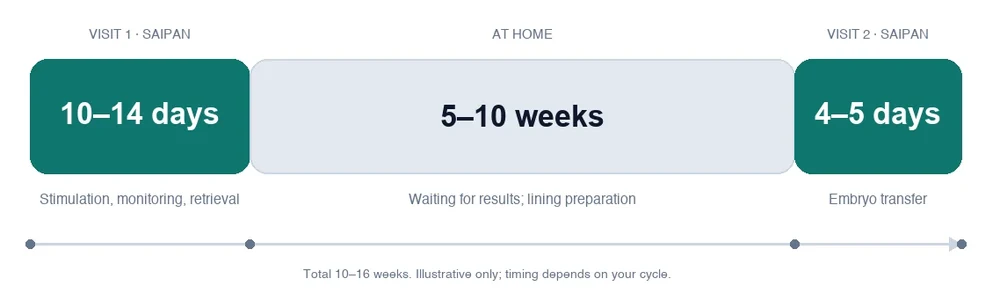
Month-by-Month Overview
The timings below describe our clinic’s schedule. Patient-education material describes one IVF cycle as taking around four to six weeks, or about three weeks when the suppression stage is not needed; the actual length depends on the protocol[1].
Before You Arrive (Weeks 1–4)
Remote consultation: Everything begins with a free consultation — by video call or in person. We review your medical history, previous fertility evaluations, and discuss your goals. This can happen from anywhere.
Pre-treatment testing: We’ll request specific baseline bloodwork (FSH, LH, E2, AMH, prolactin, thyroid) and a pelvic ultrasound to assess your antral follicle count. These can typically be done at a clinic near your home.
Protocol design: Based on your results, our medical director designs your stimulation protocol — which medications to use, at what doses, and for how long. We’ll send you a detailed preparation plan and medication list.
Visit 1: Stimulation & Retrieval (Days 1–14 in Saipan)
Day 1–2: Arrival & baseline scan Arrive in Saipan and attend your baseline ultrasound on Day 1 or 2 of your period. We confirm your ovaries are ready to respond and give you your first medication instructions.
Days 2–12: Stimulation monitoring You’ll self-administer daily injections of gonadotropins (follicle-stimulating hormones). Every 2–3 days, you’ll come in for an ultrasound + bloodwork to monitor follicle development; this close monitoring is a routine part of the stimulation stage[1]. Appointments are brief (20–30 minutes) and you’re free to explore Saipan between visits.
Day 12–14: Trigger shot When follicles reach the target size (usually 18–20mm), you receive a trigger injection timed before retrieval.
Retrieval day: Egg retrieval is a brief procedure under light intravenous sedation. How long it takes and how you recover vary from person to person, so plan the day around your clinic’s instructions and rest at your hotel afterwards.
Days 1–6 after retrieval: Embryo development In the lab:
- Day 0–1: Eggs identified and fertilized via ICSI
- Day 1: Fertilization assessment (how many eggs fertilized normally)
- Days 2–5: Embryo culture and development
- Day 5–6: Blastocyst biopsy (for PGT-A testing) and vitrification; vitrification (fast freezing) is the technique most commonly used to freeze embryos today[2]
You’ll receive daily updates on embryo development. By Day 5–6, you’ll know how many blastocysts were biopsied and frozen.
Travel home: Most patients return home 2–3 days after retrieval; the actual timing depends on recovery and your doctor’s advice.
Between Visits (Weeks 5–10)
PGT-A results (2–3 weeks): Biopsy samples are sent to our genetics lab. Results identify which embryos are chromosomally normal (euploid) and suitable for transfer. Most patients receive results within 2–3 weeks.
Endometrial preparation: If proceeding with FET, you’ll take estrogen medication (oral or patches) for 2–3 weeks to prepare your uterine lining. This can be done at home, with a local ultrasound check of your lining before traveling.
Visit 2: Embryo Transfer (Days 1–5 in Saipan)
Transfer day: A frozen embryo transfer is a simple outpatient procedure (5–10 minutes), no anesthesia required. We thaw your embryo, assess its quality, and place it in the uterus using a thin catheter guided by ultrasound. Not every embryo survives freezing and thawing[2]; whether an embryo is suitable for transfer is decided by the lab and your doctor.
Post-transfer: Rest at your hotel for the remainder of the day. Light activity is fine the next day. Many patients fly home 1–2 days after transfer — confirm the timing with your doctor first.
The two-week wait: The hardest part. 10–14 days after transfer, you do a blood pregnancy test (beta-hCG). This can be done at a clinic near your home and results sent to us.
Complete Timeline Summary
| Phase | Location | Duration |
|---|---|---|
| Initial consultation | Remote | 1 visit (video) |
| Baseline testing | Home country | 1–2 weeks |
| Protocol preparation | Home | 1–2 weeks |
| Stimulation monitoring | Saipan | 10–14 days |
| Retrieval day | Saipan | Included above |
| Embryo development | Saipan lab | 5–6 days (you can leave) |
| PGT-A results | Home | 2–3 weeks |
| Endometrial prep | Home | 2–3 weeks |
| Transfer visit | Saipan | 4–5 days |
| Two-week wait | Home | 12–14 days |
| Pregnancy test | Home lab | Day 12–14 post-transfer |
| Total from consultation to result | 10–16 weeks |
The durations in this table describe our clinic’s usual schedule; they are not a promise for an individual cycle. The actual weeks depend on ovarian response, embryo development, and lining preparation[1].
What About Fresh Transfer?
If you choose a fresh transfer (no PGT-A testing and no freeze-thaw), the entire cycle happens in one visit of approximately 18–22 days, with transfer a few days after retrieval. This reduces travel but excludes PGT-A.
Whether PGT-A is appropriate is assessed individually by your doctor based on age, previous cycles, and the embryos available; it is not a routine step for everyone. At consultation, ask what the test can tell you in your situation — and what it cannot.
Common Questions
Do I really need to stay the full 10–14 days for the first visit? The length of the stimulation and monitoring phase depends on how your ovaries respond; our clinic usually schedules it within 10–14 days. Booking a changeable flight is advisable.
How soon after retrieval can I fly home? Most patients return home 2–3 days after retrieval. This is a medical and recovery decision rather than a fixed rule, so confirm it with your doctor after retrieval.
If the first transfer doesn’t work, do we start over? If embryos remain in storage, the next transfer can be discussed with your doctor; whether another egg retrieval is needed depends on your individual situation.
Planning Tips
Book flexible flights: Retrieval timing is determined by follicle development, which can vary. We can usually predict within 1–2 days, but book flights you can change without heavy penalties.
Travel insurance: Get a policy that covers medical travel. It’s worth it.
Accommodation: Saipan has a range of hotels from budget to resort. Most patients stay at a mid-range hotel near the clinic. We can recommend options.
Partner travel: Partners are welcome (and encouraged) for retrieval day for sperm collection. For the stimulation monitoring phase, some couples travel together and use it as an opportunity to experience Saipan.
Work leave: Scheduling 12–14 days for the first visit is usually workable; the second visit of 4–5 days is easier to arrange.
Questions about your specific timeline? Schedule a free consultation and we’ll walk through your individual situation.
Further reading: Egg freezing after 35: how many to store, future use and cost stages, IVF cost guide for Saipan.